






Trauma Lab - A Reactive Body Sandbox Where Every Action Has A Reading
Trauma Lab is a free medical horror sandbox by Abynotic Studios. It simulates a body that answers back. Pick a mode, choose a tool, and the patient monitor above the table starts telling you what you did: heart rate climbs, blood pressure falls, oxygen saturation drops, and blood volume leaves the body in millilitres per second. Nothing on that monitor is scripted flavour text. The subject is reacting, and the chart is keeping a record.
The browser player above loads the same build the developer ships. Press Play in Browser, start in Sandbox if you want to poke at it freely, and watch the status pill move from STABLE to SHOCK to something considerably worse. If a browser blocks the iframe, use the fallback behaviour.
What Trauma Lab Feels Like
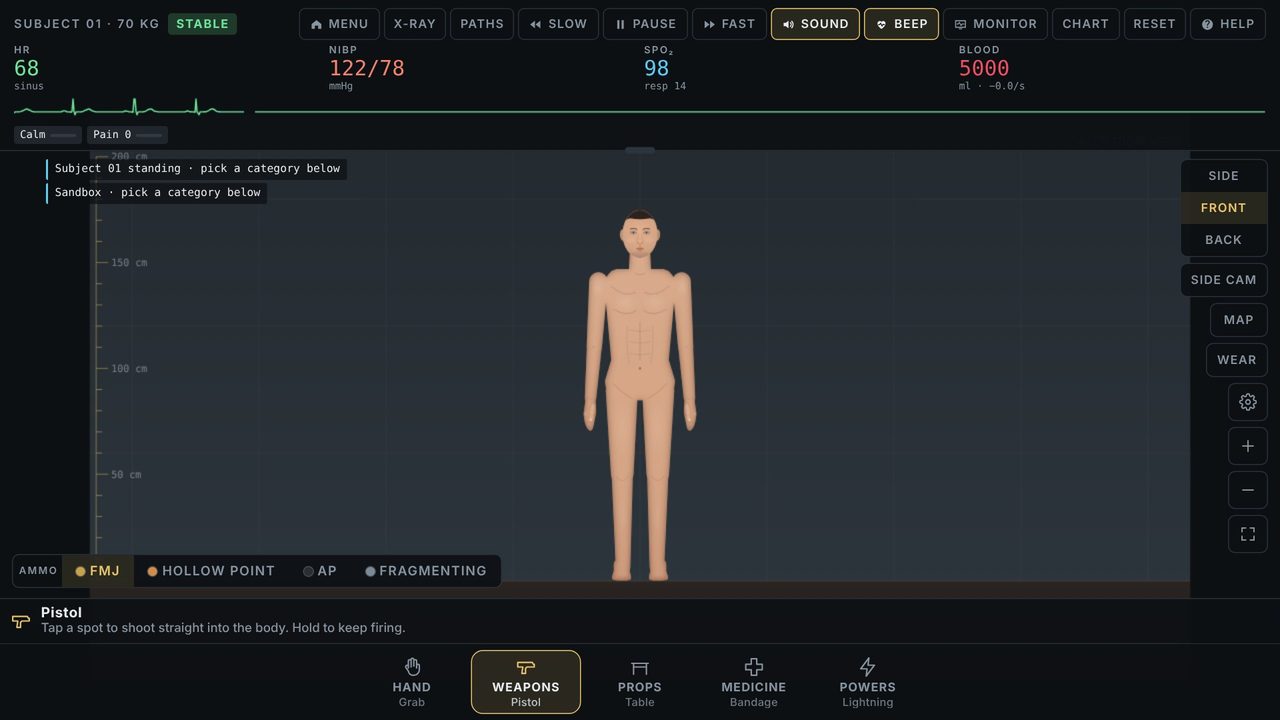
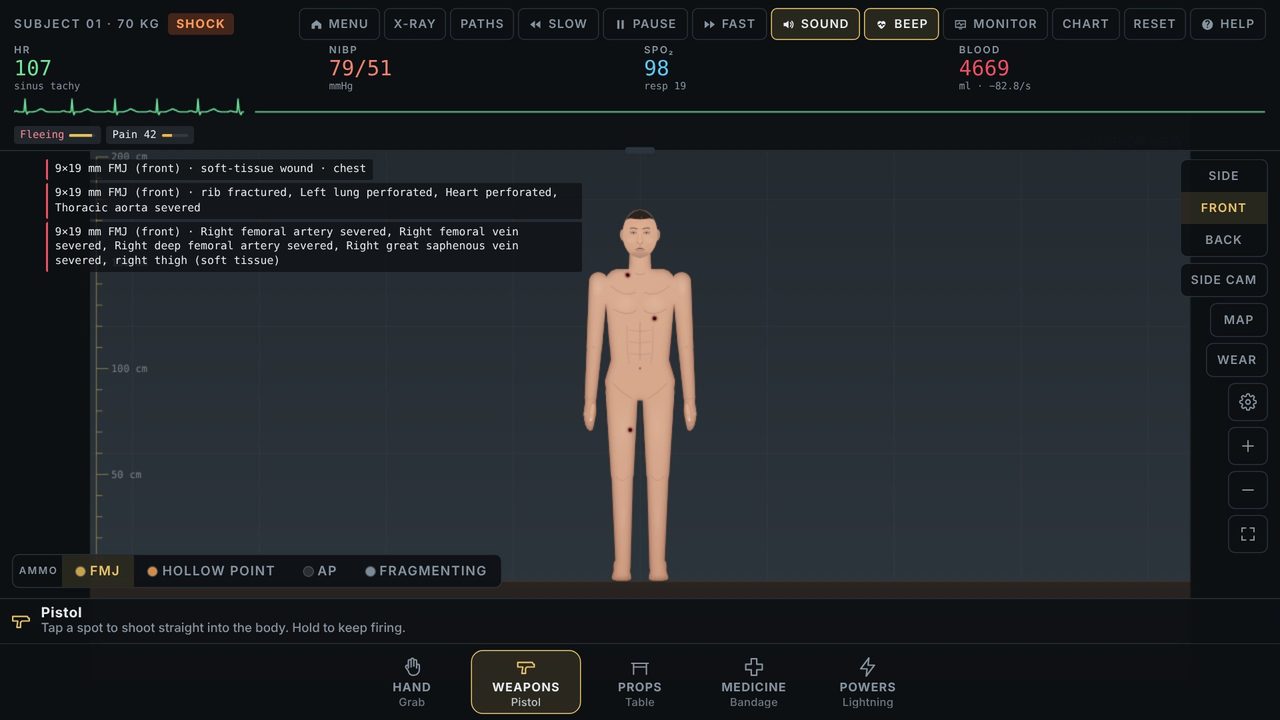
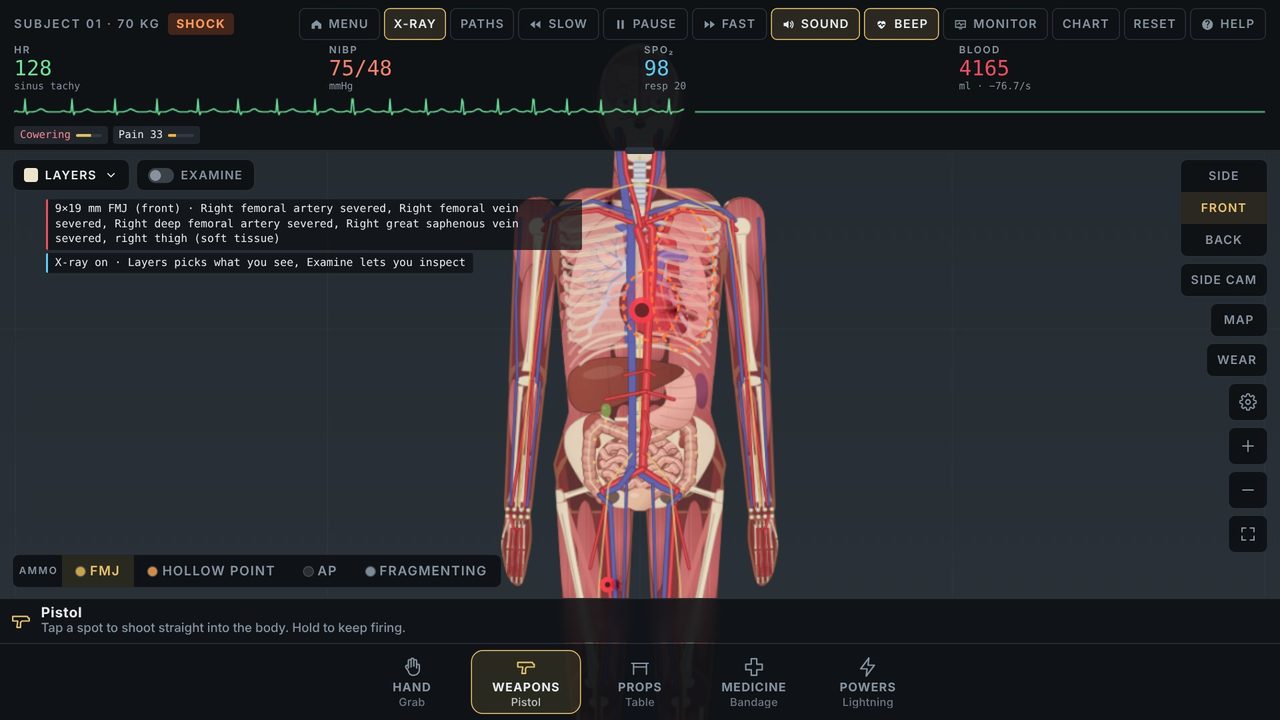
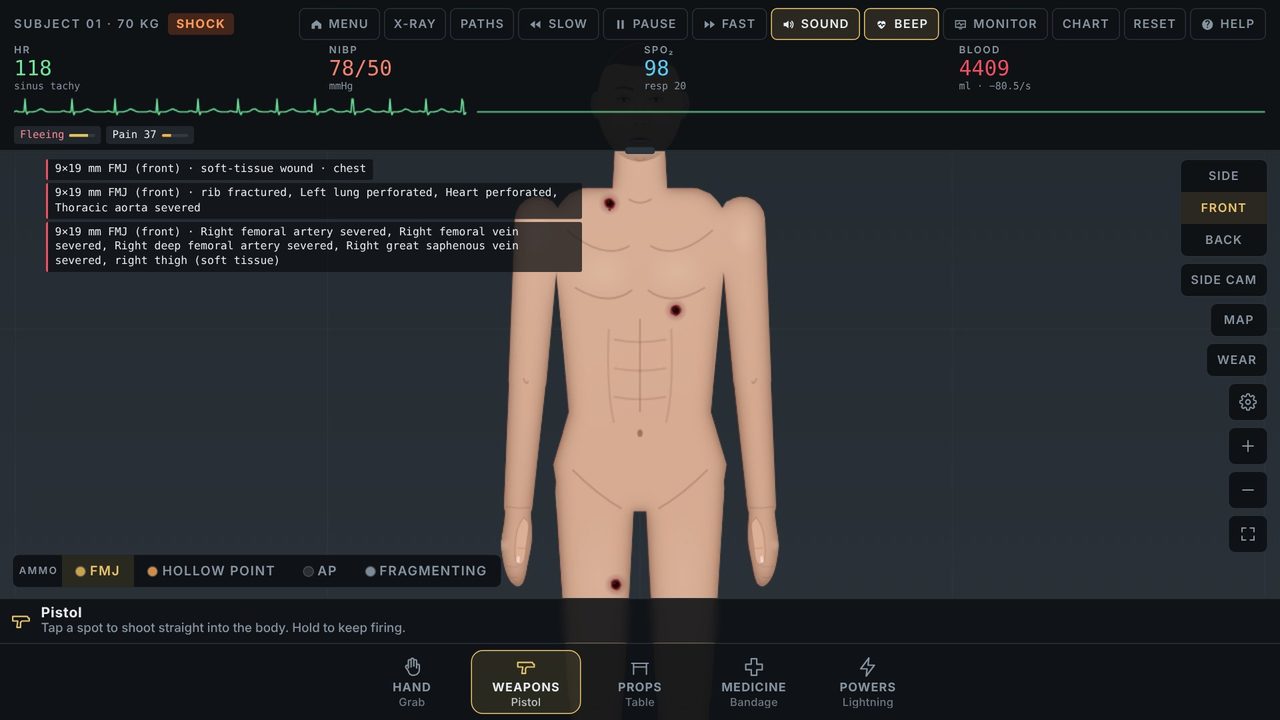
Trauma Lab is a clinical interface wrapped around a gore sandbox. The UI is the point: a patient monitor with a live ECG trace, a numeric readout for every vital, a wound log that names exactly what you did - Right femoral artery severed, Right femur a. cut - and a body you can rotate, X-ray, and dissect layer by layer. The horror is not a jump scare. The horror is reading your own work back in a chart.
That is what makes Trauma Lab land with simulation players. It gives you a bandage and a chainsaw in the same drawer and never pretends those are different activities. The X-ray view shows you the skeleton and the vasculature under the skin. The wound log tells you which artery you opened and how deep. You are never guessing - you are reading. And the simulation does not soften it, because a system that rounds off the damage would not be worth watching.
How To Play Trauma Lab
You don't need complicated controls. Pick a mode, pick a tool, act on the body, and read the monitor. On desktop a mouse is all you need, and the game slows down, pauses and fast-forwards whenever you want it to. The important part is simple: change something, then look at the numbers.
Press Play in Browser and let the build load. No install, no signup, no account.
Pick a mode. Sandbox is free play with no fixed case - it is the place to learn the tools.
Choose a tool from the category bar - Hand, Weapons, Props, Medicine, Powers - and act on the body.
Watch the monitor and the wound log, then reset and try a different approach.
The Four Ways In
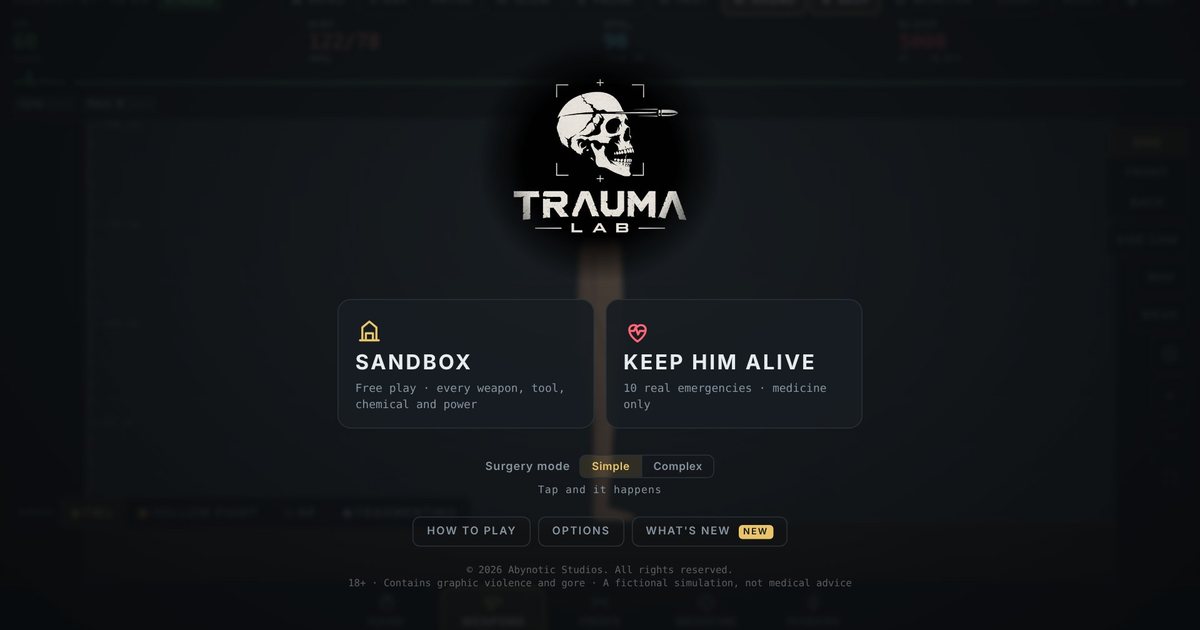
Trauma Lab is not one mode, it is four - plus the subject they all share. Each mode asks a different question, and the same tools behave differently depending on which one you picked.
Sandbox
Every weapon, tool, chemical and power, with no scenario and no timer. Nothing is on the clock, so this is where you learn what every tool actually does to a body.
Keep Him Alive
Ten real emergency cases with medicine as the only toolset. The point is the clock and the blood volume readout - keeping him alive is a decision you make every few seconds.
Mods
New guns, blades, drugs, props, clothes and rooms built by players. Bring your own room in as a zip and the simulation will treat it like any other surface.
Story Prototype
The subject is in charge here and you are not. Escape the lab, and every wound is real - which is exactly what makes this the mode that lingers after you close the tab.
Trauma Lab - Real Screenshots
All screenshots below are taken directly from the playable browser build. This is exactly what the game looks like when the monitor is running.
Why Trauma Lab Is Worth The Readout
The strongest thing about Trauma Lab is that it does not simulate a fake body. Every tool has a modelled consequence and every consequence shows up somewhere you can see - a number, a waveform, a wound log line. The gore is the reward for understanding the system, not a substitute for it.
Reactive Body
An active ragdoll that reacts like a person. Bodies collide, seize, bleed, and stop. The subject is not a prop you shoot at - it is a simulation you are participating in.
Live Patient Monitor
Heart rate with a real ECG trace, NIBP, oxygen saturation with a respiratory rate, blood volume and loss rate, pain, and the subject's anxiety or panic state. Every readout updates as you work.
A Wound Log That Remembers
Every wound is named and catalogued - which artery, which bone, how deep, and what it did to the numbers. The log reads your own work back to you, line by line.
Simple Or Complex Surgery
Switch surgery mode before you start. Simple keeps the tools usable so you can focus on the simulation; Complex makes every suture and every clamp a decision you have to earn.
X-Ray And Anatomy
Layered X-ray views with an Examine tool, plus side, front and back cameras, a side cam and a map overlay. Rotate the body and read the vasculature before you cut.
Tools And Weapons
Five categories - Hand, Weapons, Props, Medicine and Powers. Bandage, scalpel, chainsaw, taser, laser pistol, laser MG, lightning. Ammunition type changes how a wound behaves.
Four Modes
Sandbox, Keep Him Alive, Mods and the Story Prototype. Free play, ten real emergencies, player-made rooms, and the one where you are not in control.
Playable In A Browser
No install, no launcher, no account. The whole build runs in the frame at the top of this page, and Windows and Android builds exist for anyone who wants them on a device.
Tips Before You Open The Case
Start in Sandbox. Nothing is on a timer there and you can reset instantly, so it is the cheapest way to learn what a tool does before it costs you a patient. Read the on-screen prompts under the tool bar - they tell you exactly what a tap or a hold will do.
Turn on the chart. The wound log is the most under-used screen in the game. Once you can see that a chest round perforated the lung and severed the thoracic aorta, you start aiming somewhere else. The X-ray layer tells you what is underneath; the chart tells you what you did about it.
Keep an eye on blood volume, not just the heartbeat. A subject can hold a steady HR while bleeding out at 80 ml per second. In Keep Him Alive the clock is the whole game - the patient does not wait for you to finish reading the number before it drops.
Use the speed controls. Slow, Pause and Fast are all in the top bar, and they are the difference between a mechanic you understand and a mechanic you flub. Reset is not a punishment - it is the fastest way to run the same experiment twice and compare the numbers.
A Fan-Built Browser Portal For Trauma Lab
This is a fan-built browser portal for Trauma Lab, made to keep the game easy to launch, easy to revisit, and easy to share. The page focuses on the browser player, real screenshots, a clear mode breakdown, and practical troubleshooting. It is not trying to bury you in physiology before you have opened the case. The game is better when you enter with just enough context: a subject, a monitor, and one decision that you are going to have to read back in a chart later.
If you enjoy medical horror, physics sandboxes, or gore games that take their simulation seriously, Trauma Lab is worth playing slowly. If you prefer horror that hides inside a spreadsheet of vital signs, this is the right shape. If you like re-running the same emergency to see what a different order of operations does to the blood volume, the sandbox and the reset button give you all the room you need. And if all you want is a quick way to start, the player at the top of the page is the point: press play, pick a mode, and watch what the monitor says first.
Player Notes
0